
Irritable Bowel Syndrome
Symptoms, Causes… and Common Mistakes to Avoid
First, what is Irritable Bowel Syndrome (IBS) ?
-
It’s a chronic functional disorder that affects between 13% and 20% of Canadians at some point in their lives (1)
-
Functional means that medical tests often come back normal. Yet, your discomfort is very real.
How is IBS diagnosed ?
→ IMPORTANT: No self-diagnosis, please! IBS is a diagnosis of exclusion.
1. After ruling out other possible causes of your symptoms:
Here are some common tests your doctor may check first: (1)
-
Complete blood count (CBC)
-
C-reactive protein (CRP)
-
Nutritional markers
-
Celiac disease screening
-
Fecal calprotectin (to exclude inflammatory bowel disease, IBD)
2. Using the diagnostic criteria for Irritable Bowel Syndrome (IBS)
Your doctor can then make a diagnosis based on the ROME IV criteria (2)
Recurrent abdominal pain,
→ On average at least 1 day per week in the last 3 months,
→ Associated with two or more of the following:
-
Related to defecation
-
Associated with a change in stool frequency
-
Associated with a change in stool form (appearance)
Criteria must be met in the last 3 months, with symptom onset at least 6 months before diagnosis.
Irritable Bowel Syndrome (IBS): Understanding the Different Types
There are different types of IBS (Irritable Bowel Syndrome).
It’s important to know this because management can vary depending on the type 🙂

IBS-D
Diarrhea-predominant
______________
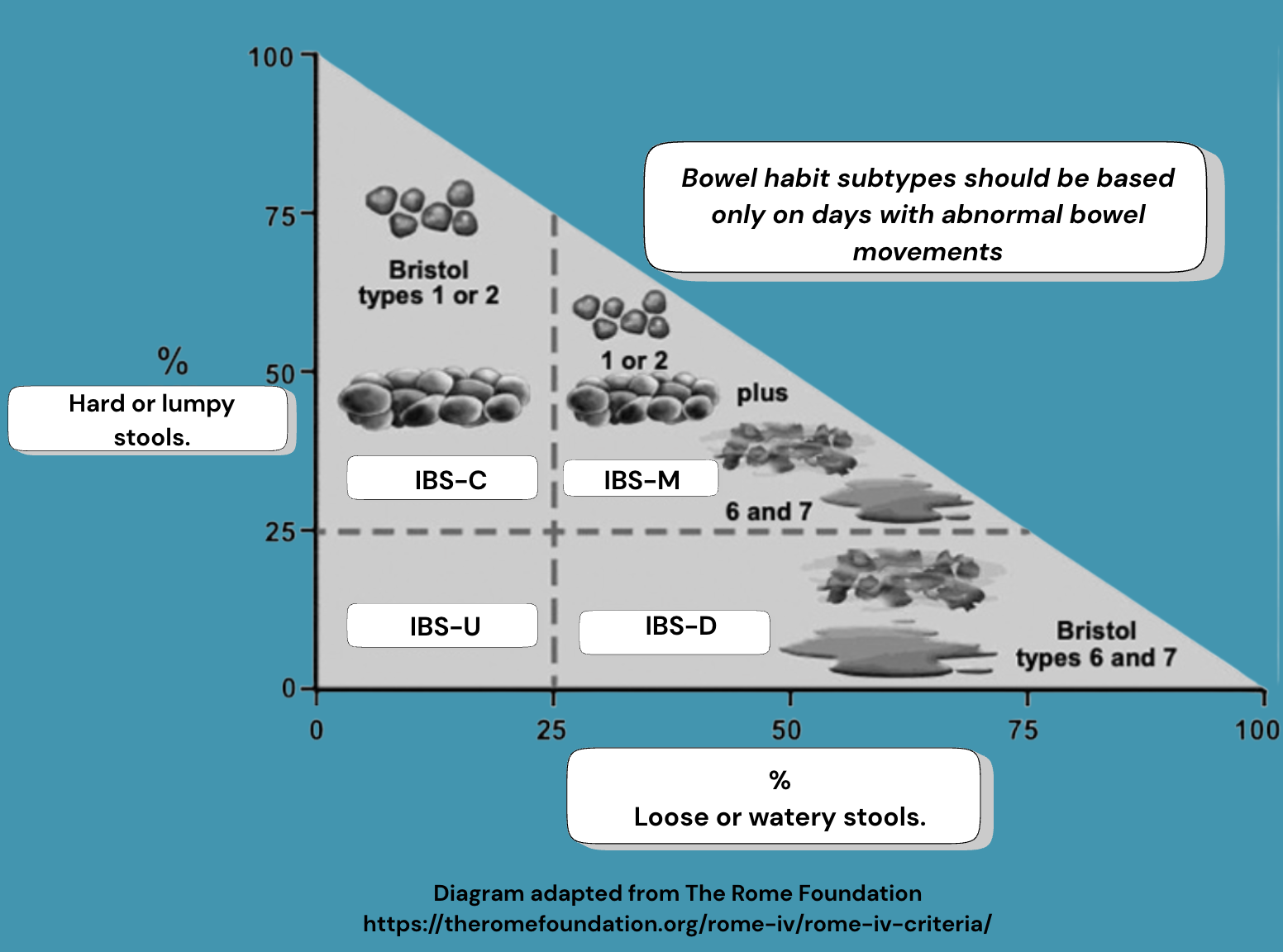
More than 25% of bowel movements are loose or watery (Bristol Stool Form Scale types 6–7), and less than 25% are hard or lumpy.
IBS-C
Constipation-predominant
______________
More than 25% of bowel movements are hard or lumpy (Bristol Stool Form Scale types 1–2), and less than 25% are loose or watery.
IBS-M
Mixed type- Alternating between constipation and diarrhea
______________
More than 25% of bowel movements are hard or lumpy AND more than 25% are loose or watery
→ Most common associated symptoms (3)
✓ Abdominal pain
✓ Bloating / gas
✓ Abnormal stool frequency
✓ Abnormal stools: constipation / diarrhea / alternating
✓ Urgency to have a bowel movement
✓ Feeling of incomplete evacuation
✓ Fatigue after meals
✓ Mucus in stools
Why Are You Experiencing IBS Symptoms ?
5 Common Causes of Irritable Bowel Syndrome (IBS) (4)
Altered Intestinal Contractions
This refers to peristalsis, the involuntary muscle contractions that move food through the digestive tract.
-
Slower-than-normal contractions can delay the transit of gas and stools, leading to constipation and hard, dry stools.
-
Stronger or longer contractions can cause gas, bloating, and diarrhea.
Brain-Gut Dysfunction
Miscommunication between the brain and intestines can cause the digestive system to overreact or underreact, leading to pain, bloating, and abnormal bowel movements.
Nerve Hypersensitivity
Some people have heightened gut sensitivity, where normal signals from the intestines are interpreted as pain or discomfort.
Post-Infectious IBS
IBS can develop after food poisoning, traveler’s diarrhea, or gastrointestinal infections, which may alter gut function temporarily or long-term.
Dietary Factors
Food-related triggers such as allergies, intolerances, or poor eating habits can worsen symptoms
Stress - Anxiety
Whether physical or emotional, can trigger IBS symptoms
4 Common Mistakes That Can Worsen IBS Symptoms
Making certain mistakes can aggravate your Irritable Bowel Syndrome (IBS) and negatively impact both your digestion and overall well-being.
Here are four frequent errors to watch out for:
Taking supplements randomly.
Not all supplements are beneficial.
Some may help, but others can be ineffective or even harmful, wasting your money and potentially affecting your digestive health
Focusing only on what you eat VS how you eat it.
Skipping meals/Arriving at meals extremely hungry usually leads to eating too fast without chewing properly.
This can exacerbate IBS symptoms.
Ignoring fiber needs or using the wrong type
Exemple:
Not getting enough soluble fiber (like oats, psyllium) can worsen constipation.
Using too much insoluble fiber (like raw bran) may increase bloating and gas.
And the worst of them all : Starting a Restrictive Diet on Your Own
Cutting out gluten or starting a restrictive diet, like a low-FODMAP diet, without guidance is strongly discouraged !
Doing so can lead to:
-
Nutritional deficiencies: insufficient fiber intake can affect your gut microbiota, and deficiencies in calcium, vitamin B12, and iron are common.
-
Increased food-related anxiety
-
Higher risk of disordered eating patterns
-
Social isolation and avoidance
-
Negative impact on mental health
3 Tips to Start Relieving Your IBS Symptoms Today
Don’t wait more than 4 hours between meals
Eating every 4 hours in average supports gut motility and the migrating motor complex (MMC): The gut’s natural cleaning cycle.
Too frequent meals can disrupt the MMC, while waiting too long can lead to overeating and digestive discomfort.
Chew your food thoroughly
Aim for a smooth, almost purée-like texture.
Proper chewing helps digestion and reduces gas and bloating.
Add soluble fiber to your diet
Examples:
-Sprinkle chia seeds into your breakfast or smoothie.
-Favor cooked vegetables at lunch to make them easier on your digestive system.
What now ?
You might want to try managing this on your own before consulting… that’s understandable.
But be careful: you wouldn’t try to represent yourself in court without legal training!
If your symptoms don’t improve after 1–2 months of self-management, it’s time to consult a nutrition professional.
References:
- Canadian Society of Intestinal Research. (n.d.). IBS. BadGut. https://badgut.org/information-centre/a-z-digestive-topics/ibs/
- Rome Foundation. (n.d.). Rome IV criteria. https://theromefoundation.org/rome-iv/rome-iv-criteria/
- Canadian Digestive Health Foundation. (n.d.-a). Boîte à outils du SII pour les personnes nouvellement diagnostiquées. https://cdhf.ca/fr/boite-a-outils-du-sii-pour-les-personnes-nouvellement-diagnostiquees/
- Canadian Digestive Health Foundation. (n.d.-b). Irritable bowel syndrome (IBS). https://cdhf.ca/fr/digestive-conditions/irritable-bowel-syndrome-ibs/
- Simons, M., Taft, T. H., Doerfler, B., Ruddy, J. S., Bollipo, S., Nightingale, S., Siau, K., & van Tilburg, M. A. L. (2022). Narrative review: Risk of eating disorders and nutritional deficiencies with dietary therapies for irritable bowel syndrome. Neurogastroenterology & Motility, 34(1), e14188. https://doi.org/10.1111/nmo.14188